

AI is quickly making its mark in almost every part of daily life. From content creation to customer support, learning, and brainstorming, its applications extend beyond communication. Models like ChatGPT, Gemini, and Claude can now handle complex tasks in seconds, saving both time and cost. Brands that leverage AI can focus more on creativity and innovation, leaving the repetitive tasks to trained models.
AI has already transformed the packaging industry. A few years ago, designers used to spend hours creating prototypes, adding colors, maintaining hierarchies, and then giving it the final 3D shape. Now, AI can do these things cleanly and quickly. From designs to materials, printing, and finishing techniques, it gives packaging experts valuable information and references. In this post, we will explore how AI is reshaping the packaging industry and how you can best use AI for your packaging company.
The guide is equally valuable for brands ready to order custom packaging boxes.
How AI Can Help Packaging Experts
We are disappointed to see that countless packaging companies are still not using AI. What is even more shocking is that neither the lack of resources nor the team’s capability is restricting them from using AI. What stops them is the lack of information. Companies still don’t know how AI can help them finish their work faster while maintaining the same quality level. At The Box Lane, we continuously test AI capabilities for packaging designs and creativity.
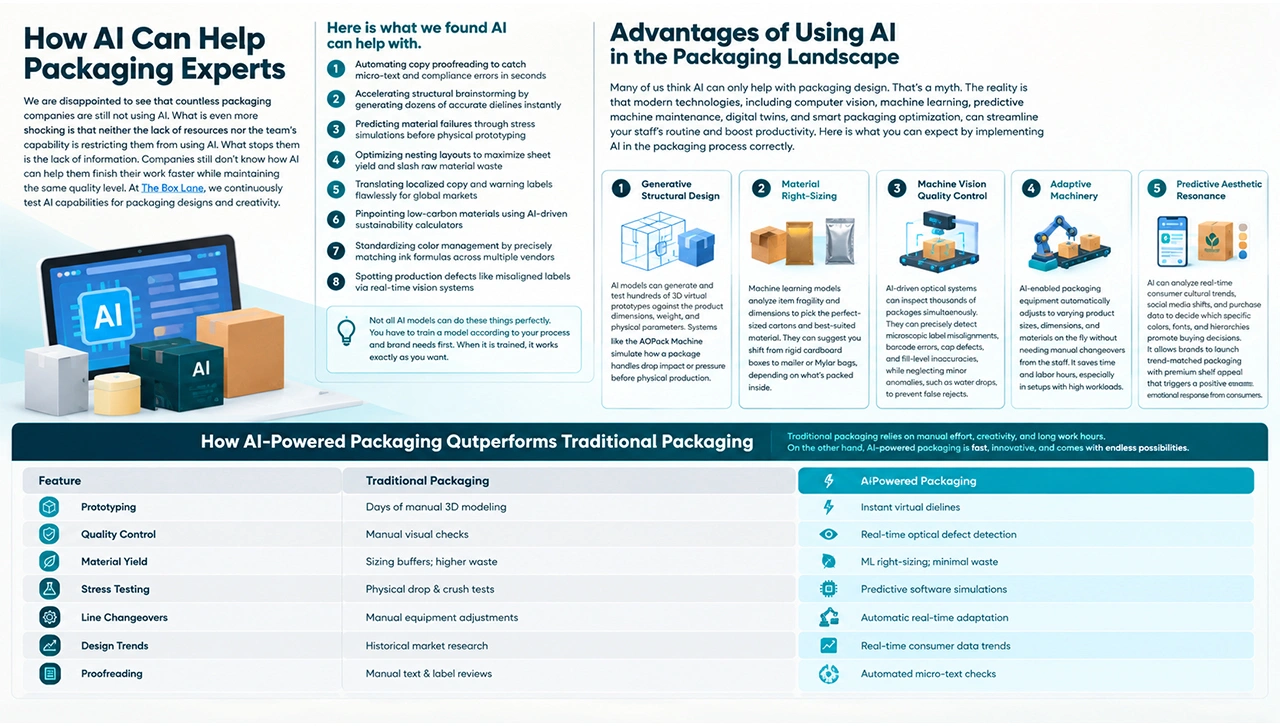
Here is what we found AI can help with.
-
Automating copy proofreading to catch micro-text and compliance errors in seconds
-
Accelerating structural brainstorming by generating dozens of accurate dielines instantly
-
Predicting material failures through stress simulations before physical prototyping
-
Optimizing nesting layouts to maximize sheet yield and slash raw material waste
-
Translating localized copy and warning labels flawlessly for global markets
-
Pinpointing low-carbon materials using AI-driven sustainability calculators
-
Standardizing color management by precisely matching ink formulas across multiple vendors
-
Spotting production defects like misaligned labels via real-time vision systems
Not all AI models can do these things perfectly. You have to train a model according to your process and brand needs first. When it is trained, it works exactly as you want.
Advantages of Using AI in the Packaging Landscape
Many of us think AI can only help with packaging design. That’s a myth. The reality is that modern technologies, including computer vision, machine learning, predictive machine maintenance, digital twins, and smart packaging optimization, can streamline your staff's routine and boost productivity.
Here is what you can expect by implementing AI in the packaging process correctly.
Generative Structural Design
AI models can generate and test hundreds of 3D virtual prototypes against the product dimensions, weight, and physical parameters. Systems like the AOPack Machine simulate how a package handles drop impact or pressure before physical production.
Material Right-Sizing
Machine learning models analyze item fragility and dimensions to pick the perfect-sized cartons and best-suited material. They can suggest you shift from rigid cardboard boxes to mailer or Mylar bags, depending on what’s packed inside.
Machine Vision Quality Control
AI-driven optical systems can inspect thousands of packages simultaneously. They can precisely detect microscopic label misalignments, barcode errors, cap defects, and fill-level inaccuracies, while neglecting minor anomalies, such as water drops, to prevent false rejects.
Adaptive Machinery
AI-enabled packaging equipment automatically adjusts to varying product sizes, dimensions, and materials on the fly without needing manual changeovers from the staff. It saves time and labor hours, especially in setups with high workloads.
Predictive Aesthetic Resonance
AI can analyze real-time consumer cultural trends, social media shifts, and purchase data to decide which specific colors, fonts, and hierarchies promote buying decisions. It allows brands to launch trend-matched packaging with premium shelf appeal that triggers a positive emotional response from consumers.
How AI-Powered Packaging Outperforms Traditional Packaging
Traditional packaging relies on manual effort, creativity, and long work hours. On the other hand, AI-powered packaging is fast, innovative, and comes with endless possibilities. The table below gives a head-to-head comparison.
|
Feature |
Traditional Packaging |
AI-Powered Packaging |
|
Prototyping |
Days of manual 3D modeling |
Instant virtual dielines |
|
Quality Control |
Manual visual checks |
Real-time optical defect detection |
|
Material Yield |
Sizing buffers; higher waste |
ML right-sizing; minimal waste |
|
Stress Testing |
Physical drop & crush tests |
Predictive software simulations |
|
Line Changeovers |
Manual equipment adjustments |
Automatic real-time adaptation |
|
Design Trends |
Historical market research |
Real-time consumer data trends |
|
Proofreading |
Manual text & label reviews |
Automated micro-text checks |
Embrace the Future of Custom Packaging with The Box Lane
At The Box Lane, we blend human creativity with AI-powered innovation to design, create, and print custom packaging that looks premium on shelves and protects products. From perfect sizing to elegant finishing and durable materials, we pay attention to every detail.
Contact us to get custom boxes that make your brand stand out.
FAQs
How does AI improve custom packaging design?
AI instantly generates precise 3D dielines and virtual prototypes that help reduce turnaround times from days to seconds.
Can AI reduce material waste in packaging production?
Yes, machine learning algorithms optimize sheet layout nesting and right-size cartons to minimize raw material waste.
What is machine vision quality control in packaging?
Machine vision uses AI-powered optical sensors to inspect thousands of packages per minute. It catches microscopic defects in real time.
How do predictive stress simulations prevent packaging failures?
AI simulates drop impacts and compression stress on virtual models. It allows engineers to fix structural weaknesses before physical production.
Does AI replace human packaging designers?
No, AI automates repetitive structural and proofreading tasks, not replacing human designers. It allows human designers to focus on high-level creativity and brand strategy.