


Storing products for a longer duration has been a challenge since prehistoric times. If we look back in history, various preservation methods, such as salting, fermentation, and drying, were used for this purpose. With the innovation in the industry, Mylar bags have evolved as the most reliable option for maintaining product freshness over extended periods. They prevent deterioration and degradation of stored content. The high preserving power of these pouches is due to their excellent barrier properties, as they have a layered structure, aluminum foil, and a strong yet flexible design.
The airtight seal of Mylar bags determines directly how long the stored content will remain intact. Even nowadays, many people don’t know how to seal and store a Mylar bag accurately for long-term benefits. The purpose of this practical guide is to educate homeowners and business owners about the best sealing and storing techniques of Mylar bags, along with the common mistakes and how they can prevent them.
Let’s absorb the information section by section.
The Importance of Accurately Sealing and Storing Mylar Bags
Accurately sealing a Mylar bag is as important as using it for product preservation. The airtight seal provides these bags with an excellent barrier for gases, water vapors, and light. These three elements are the main culprits that lead to microbial growth, foul odors, and degradation of stored elements.
Proper storage is also important to keep the deteriorating factors at bay. A cool, calm, and dry place is generally recommended for storing these boxes. Failure to do so can accidentally expose the ingredients to harmful gases or UV rays, thereby accelerating the degradation and reducing the shelf life.
Popular Sealing Methods for Mylar Bags
There are various sealing options for Mylar bags, with each having its own pros and cons. Sealing methods for household use may differ from those of manufacturing units, with shelf life, protection capacity, and intactness. The same is true for product variations. Make sure to add accurately sized oxygen absorbers before you move toward the sealing process. It will help remove the residual oxygen, extending the shelf life.
Here are some of the popular sealing options;
Heat Sealing
This is the most popular and widely used option for sealing. It utilizes the heat and pressure to melt the material of the bag. The two sides of the bag are packed together, creating a perfect, resistive seal.
Impulse Sealing
This is the best method for precise and convenient sealing. It passes the electric current through a heating wire for a specific time duration, which melts the bag material and creates a strong seal. You can adjust the temperature and duration according to the thickness and quality of the bag.
Vacuum Sealing
This is not generally considered a standard method for sealing Mylar bags. However, it can be used before heat sealing to remove the residual oxygen from the bag. This method adds an extra layer of preservation to the stored elements.
Band Sealing
This is a modern, automated option for sealing. It is done by using a band sealer, which consists of a conveyor belt, heated bands, and a cooling section. The bag is placed on the belt, where it is pulled and passes through the heated bands and then a cooling section, creating a protective seal.
Zipper Sealing
This is the ideal method for sealing reusable bags. First, close the zipper securely, and then create a seal with a suitable heat or impulse sealer. The zipper adds an extra layer of security and protection. To reuse them, close the zipper again and repeat the sealing method.
What Else to Consider:
You can also use some household appliances, like a clothing iron or a hair straightener, for sealing purposes. These methods are not ideal for very long shelf lives or for industrial usage. However, you can use them for storing kitchen ingredients, dried fruits, etc, for short periods.
Tips for Checking the Intactness of Mylar Bags' Seal
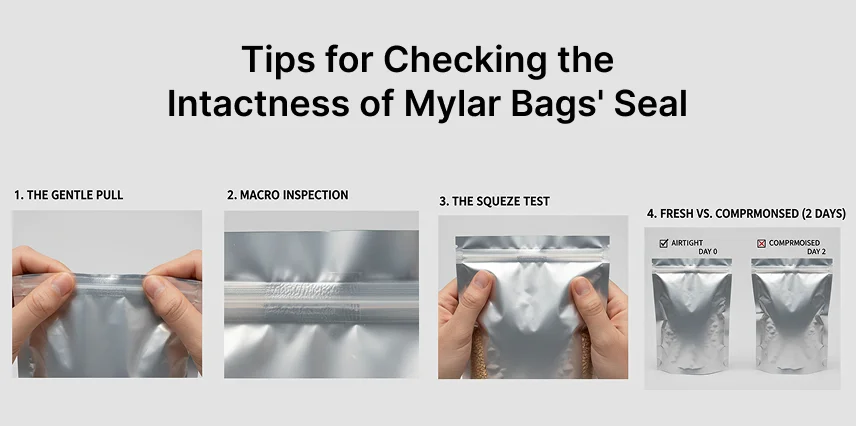
Creating a seal isn’t enough; you must create an airtight, perfect seal to ensure long-term protection of products. Only a proper seal can prevent exposure to environmental factors like oxygen, moisture, and light. Here is what you can do to check the quality and intactness of the seal;
- Gently pull the two sides of the bag. If both sides are held firmly and are not easy to separate, the seal is permanent.
- Check the seal for any visible gaps. Even a small hole in the seal can allow plenty of gases to penetrate, causing foul odors and degradation of products.
- Close your hands around the bag and apply gentle pressure. If there is no hissing sound (which comes due to air leakage), the seal is intact.
- Check the bag after two days. If it looks puffy, it means the seal is compromised and the air has leaked in. In this case, consider resealing.
Ideal Conditions for Storing Mylar Bags
Once you are done with the sealing Mylar bags, choose the best place for storing them. Ideally, it is recommended to place the bag within an external protective covering. You may use a bucket or a steel container with a solid, tight lid for this purpose. It protects the bag from physical damage, tears, and punctures.
For storage, choose a cool, dry, and dark place. It is because at such places, there is minimal risk of accidental exposure to harmful environmental components.
Common Mistakes to Avoid Sealing Mylar Bags
Although it seems a simple task, sealing a Mylar bag requires careful consideration of multiple factors. A slight negligence can bring you far away from your long-term storage goals. Here are some common mistakes that must be avoided when sealing Mylar packaging.
- Never stuff items in the bag, as it may lead to punctures.
- Never forget to use oxygen absorbers, as they remove leftover oxygen.
- Never store the bag with incomplete seals. It can degrade items in only a few days.
- Never store near moisture or a hot place, as heat can ruin your stored content.
- Never use low-quality bags for bulky or more sensitive items.
Final Thoughts

Accurate sealing and storage of Mylar bags is essential for long-term storage of products. There are a lot of sealing methods and appliances to create a seal on Mylar pouches, each with its own benefits and conveniences. Adding oxygen absorbers, sealing accurately, and storing at cool, dry conditions can preserve the freshness and nutritional value of your stored content for years.
If you want to learn more about Mylar bags, you can read our other blogs for useful information and practical guides. If you want to purchase Mylar bags for your household use, small business, or manufacturing unit, you can explore our popular products at The Box Lane or contact us at 484-224-2666.
FAQs
Can I reseal a Mylar bag once I have opened it?
Yes, you can reseal it after opening it. Most of the Mylar bags are reusable, which means they can be sealed multiple times and used again and again. But remember, sealing is not just closing the zipper. Ensure proper sealing using a suitable sealer.
Should I use vacuum sealing options for Mylar bags?
You can use vacuum sealing options, but make sure to use them along with a proper heat sealing or band sealing method and use the oxygen absorbers. Alone use of vacuum sealing is not an ideal method and might not yield satisfactory results.
Is it mandatory to store Mylar bags upright?
Storage positions have nothing to do with the integrity of the stored content. However, upright storing can have some benefits, like easier identification while lying on the shelf, better organized space, etc.
How long do sealed Mylar bags last?
The shelf life of different products is different when stored in Mylar bags. Generally, sealed Mylar bags last from 5 to 25 years when packed with oxygen absorbers, sealed properly, and stored at favorable conditions.
Can I seal Mylar bags with an iron?
Yes, you can use an iron to seal these pouches. But using iron is not recommended for large-scale or if you are using it in a manufacturing industry. For short-term storage, iron sealing can be used.