


At The Box Lane, we frequently encounter a question,
Can I use Mylar bags in the freezer?
The answer is a big "YES." You can, and you should use these preservative pouches in the freezer. The common applications involve storing meat, freeze-dried products, and dry foods. In this concise guide, we will explore the best practices and the mistakes to avoid when using Mylar in a freezer.

How Mylar is Better than Standard Freezer Bags
A Mylar bag is the big boss for freezer storage. It is far better than standard freezer bags and vacuum-sealed bags. This superiority aligns with its unique, layered structure. Ordinary plastic bags or vacuum-sealed bags become porous at the molecular level when stored at extremely low temperatures. The result is that oxygen and moisture can penetrate the bag, causing freezer burn. All the stored food will soon degrade and spoil.
On the other hand, Mylar remains structurally stable even at very low temperatures. This is due to an embedded aluminum layer, which effectively blocks oxygen and moisture. Apart from this, Mylar is puncture-resistant and very stable towards mechanical damage. As a consequence, there are very low chances that any outside agent can interfere with the goods stored inside, even at -100°F. This is what makes Mylar ideal for storage in a freezer.
A Quick Comparison
Here is a quick comparison between Mylar, a standard freezer bag, and a vacuum-sealed bag.
|
Feature |
Standard Freezer Bag |
Vacuum Seal Bag |
7-Mil Mylar Bag |
|
Oxygen Barrier |
Poor |
Moderate |
Excellent |
|
Light Block |
0% |
0% |
100% (Opaque) |
|
Freezer Burn Risk |
High |
Medium |
Near Zero |
|
Storage Life |
3–6 Months |
1–2 Years |
5+ Years |
The Dos of Freezer Storage with Mylar
Here is what you should do to store goods for longer periods with Mylar.
Sacrificial Bag Technique
When frozen, your stored goods can develop sharp edges. There is a risk that your bag might get punctured due to a steak bone or a dehydrated pasta. If punctured, your stored ingredients are no longer preserved.
To prevent this issue, you should add a sacrificial bag. Place your goods in a standard sandwich bag, and then add this complete package inside the Mylar bag. It ensures your pouch stays puncture-resistant.
Leave Room for Expansion
When your goods freeze, they may expand by up to 9%. This expansion needs a space. If you fill your bag to the top, it will explode due to the pressure of thermal expansion.
The good practice is to leave at least 2 inches at the top. This space is sufficient to accommodate any expansions if they occur.
Use Correct-Sized Oxygen Absorbers
When you store dry goods, using oxygen absorbers is recommended. This is essential to eliminate oxidation risks due to any residual oxygen. Failing to do so can start the spoilage and degradation process inside the bag.
To ensure safe storage, you should add a relevant-sized oxygen absorber packet depending on the pouch size and goods stored.
Heat Seal Properly
Use a professional-grade sealer to create an airtight seal. Using an impulse heat sealer is generally recommended. If the bag has a zipper or any other locking mechanism, create the seal above it. Place the bag in the sealer, press for 2 to 3 seconds at a high temperature, and check visually whether the seal is of good quality.
Creating two parallel seals is another good practice for additional protection.
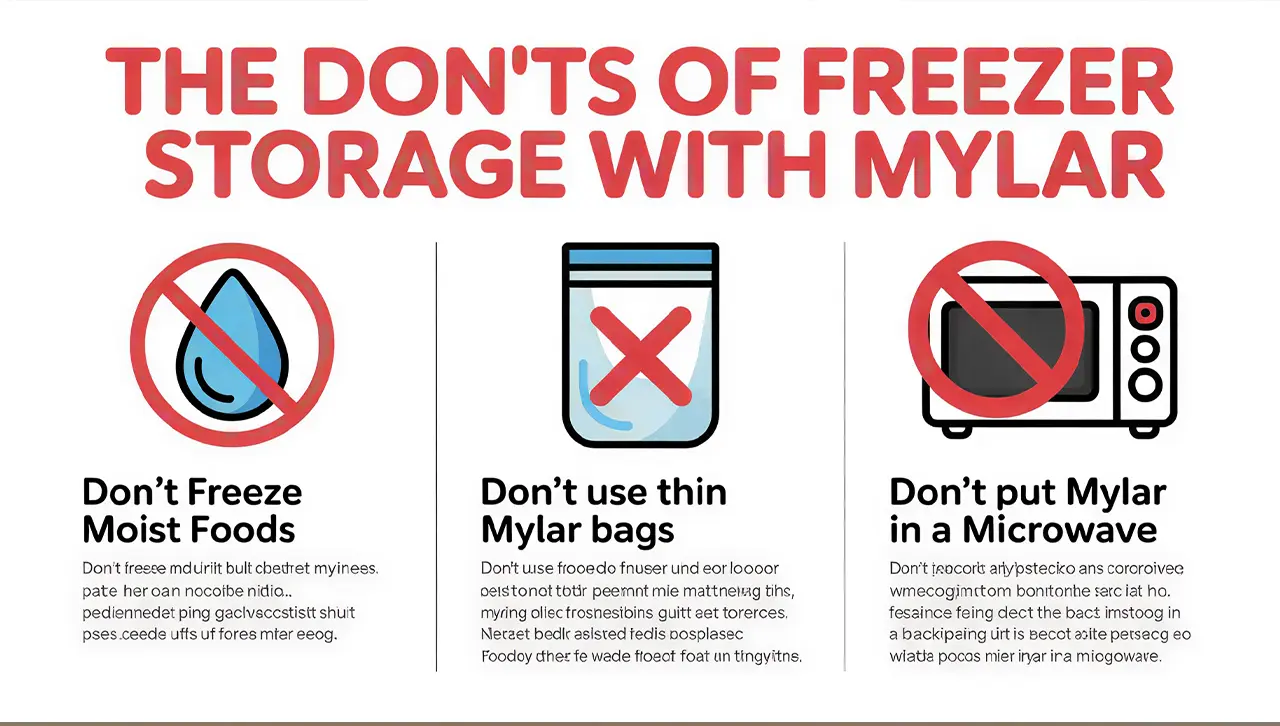
The Don’ts of Freezer Storage with Mylar
Here is what you should avoid when storing goods with Mylar in a freezer.
Don’t Freeze Moist Foods
Don’t confuse Mylar storage with standard freezer storage. Mylar is best used for dry goods, not for the moist ones. If you have moist items such as fresh vegetables, store them inside a freezer, not inside a Mylar bag at room temperature. If you store goods with high moisture content in the Mylar, it creates a botulinum risk, which is severe for health concerns.
Don’t Use Thin Mylar Bags
The thicknesses of the Mylar vary greatly, from 3 mil to 7 mil on average. For use in a freezer, you should opt for 5- to 7-mil bags. It is recommended because the environment in the freezer can get bitter. Thin bags might rupture at sub-zero temperatures. It can also be due to the strain of the goods inside that are continuously expanding when freezing.
Don’t Put Mylar in a Microwave
Don’t make the mistake of placing the entire Mylar bag into the microwave. Mylar has a middle layer of aluminum, and it may catch fire when directly placed inside a microwave. Instead, take the food outside of the pouch, preferably in a steel container, and then place it in a microwave for heating purposes.
Final Words
Mylar is one of the best options for freezer storage. Just place your dry food in a sacrificial bag and then place it into Mylar. Leave at least 2 inches at the top and create a perfect seal. Now you can use this bag for freezing purposes. Handle the process carefully and avoid mistakes such as ignoring oxygen absorbers, using moist food, or choosing thin bags.
If you want to purchase some high-quality Mylar bags for freezer storage, The Box Lane is a great choice for you. Explore popular options on our site or contact us for a custom design and style.
FAQs
How long does food last in Mylar bags in the freezer?
When stored with oxygen absorbers, heat-sealed dry goods can last as long as 10 to 15 years inside the Mylar bag.
Do I need a vacuum sealer for Mylar bags?
Not necessarily. You can use an impulse heat sealer for sealing. For removing residual air, however, you can use a vacuum sealer. You can also use a straw method or just compress the bag manually to evacuate air.
Is Mylar better than vacuum-sealed bags for the freezer?
Yes. Mylar provides complete protection from light, oxygen, and moisture. On the other hand, standard vacuum bags can gradually allow oxygen to penetrate after some time.
Can I vacuum-seal Mylar bags for the freezer?
Yes, you can, but with a slight modification. A standard vacuum sealer is not compatible with the smooth surface of standard Mylar bags. You need either a chamber vacuum sealer or a textured Mylar bag for vacuum sealing.
Will Mylar bags crack in the freezer?
If the bag is of high quality and of good thickness, it won’t get cracked. The key is to use a bag with around 7 mil thickness and avoid folding to prevent puncture and cracking issues.