

Mylar bags are one of the most widely used packaging materials all over the world. This widespread use is due to its efficient preservation and barrier properties. Whenever purchasing Mylar bags for their products, many business owners are stuck with a single, confusing question. Are Mylar bags sustainable? This guide is based on the true, fact-based evaluation of Mylar sustainability. We are going to uncover both its pros, such as reduced food waste, as well as the cons, such as difficulty in recycling.

What is Sustainable Packaging?
Before we specifically discuss the sustainability of the Mylar bags, let’s first understand what makes packaging sustainable. Many of us think sustainability is all about a packaging being biodegradable or easy to dispose of. That’s not true at all. In fact, a packaging is perceived as sustainable if it accompanies;
- Fewer raw materials for production.
- Reduced environmental impact.
- Easily recyclable and reusable.
- Reduced manufacturing waste.
- Reduced risk of spoilage.
- Long-lasting functionality.
- Low carbon footprint.
- Extended shelf life.
Structure and Properties of Mylar Bags with Respect to Sustainability
Mylar bags have a multi-layered structure composed of polyethylene terephthalate (BoPET), an aluminum foil, and an inner layer of food-grade polyethylene (PE). This unique structure gives Mylar bags excellent barrier properties, preserving the stored content for longer periods. At the same time, it poses various challenges to disposal and recycling. Mylar bags are generally not easy to recycle with standard municipal programs.
Eco-Friendly Advantages of Mylar Bags
Although traditional Mylar bags are not biodegradable, they are accompanied by numerous advantages related to eco-friendliness. Here are some of those benefits mentioned;
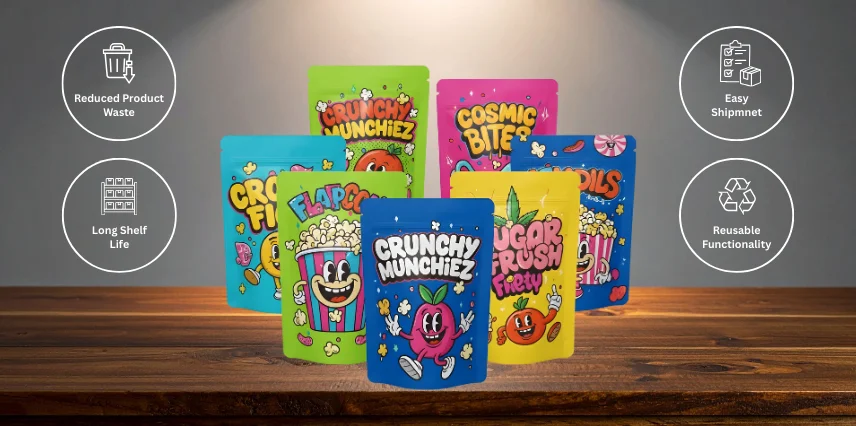
Reduced Product Waste
Mylar bags feature an excellent protection barrier. Their tertiary layered structure prevents them from moisture, gases, and direct sunlight. Due to these properties, Mylar bags can preserve a wide range of organic and industrial products for longer periods. From food to medicines, cannabis, and electronics, a wide spectrum of products can be stored in these bags. When used with correctly sized oxygen absorbers, they prevent the stored ingredients from spoilage, mold and mildew attack, and other degradation processes. The outcomes of all this are reduced spoilage, reduced product waste, and ultimately reduced environmental contamination, which is a huge benefit towards sustainability.
Long Shelf Life
Mylar bags are extremely durable and tear-resistant. It means you can use them to store your household products for longer periods of time. In this way, they eliminate the need for more packaging materials and ultimately contribute to preserving nature with less manufacturing, less carbon footprint, and less environmental damage.
Easy Shipmnet
As mentioned earlier, Mylar bags are lightweight and require fewer materials for manufacturing. Due to their lower weight, they take up less space for storage and are easy to transport. What’s the outcome of a compact and low-weight design? A bulk amount can be shipped via a single vehicle. It consumes low fuel, with low carbon emissions, and ultimately proves beneficial for nature.
Reusable Functionality
Most of the Mylar bags, especially those with zippers or other locking mechanisms, can be washed and used again. This is a huge benefit towards sustainability as it eliminates the need for new production every time a consumer wants to store some goods.
Popular Recycling Techniques for Mylar Bags
One of the common myths in the market is that Mylar bags are not recyclable at all. This is a false assumption, and the reality is something different. Mylar bags are not readily recyclable with most of the standardized recycling techniques. But these packaging materials can be recycled with more specialized methodologies. These techniques are carried out at specific centers only.
Here are some of the primary recycling options for the Mylar bags;
Chemical Delamination
It is also sometimes known as solvent-based recycling. This method uses chemical solvents to dissolve the adhesive bond between the plastic and metallic layer. The resulting substrate is then subjected to agitation and heat, where all the layers are completely segregated. These layers are then removed from the chamber via density gradient or filtration methods. At the next step, plastic and aluminum are used separately.
Thermal Depolymerization
This method is also known as pyrolysis. Mylar bags are subjected to a very high temperature (400°C to 700°C) in an oxygen-free environment. The mylar layers are depolymerised into their original building blocks, which are hydrocarbons. This organic mixture is then separated from the solid metals. Once separated, both substrates are subjected to separate recycling.
Physical Separation Methods
In this technique, the composite materials of the Mylar are sorted out based on their physical properties. The material is first subjected to mechanical shredding and washing. After this, the substrate is passed through an electric field. The conductive aluminum pieces acquire a charge and are attracted toward the opposite side of the insulated plastic. In this way, both elements are separated and then reused accordingly.
Biodegradable Mylar Bags Available Today!
Traditional Mylar bags pose a challenge when it comes to end-of-life management. They are not easily recyclable or disposable. The reason for this conundrum is that Mylar bags contain multiple elements. The difficulty arises in separating these materials as they are firmly bound.
With improvements in eco-conscious practices, many eco-friendly alternatives are being made. Here are some modern additions to the Mylar bags to make them more eco-friendly.
- Recyclable mono-material PET mylar bags.
- Biodegradable PET blends (emerging market).
- Water-based ink printing.
- Low-impact manufacturing practices.

Conclusion
Mylar bags are one of the most popular packaging materials in this era. They offer numerous benefits, including high preservation, long shelf lives, and reusable benefits. They are not easily biodegradable or recyclable with most standard techniques. Still, they tend to reduce environmental negative impact in a variety of ways. Nowadays, many sustainable alternatives to traditional Mylar bags are being used actively. This will definitely contribute to bringing the packaging industry to the next level.
Looking to purchase eco-friendly Mylar bags? Explore our premium packaging solutions at The Box Lane.
FAQs
Are traditional Mylar bags biodegradable?
The honest answer is no. They are not biodegradable. However, they offer numerous benefits in terms of long-term usage and efficient protection barrier.
Are there any sustainability benefits of Mylar bags?
Yes, there are multiple sustainability benefits. Some of them include reduced food waste, easy shipment, reduced carbon emissions, and less raw materials consumed.
What is a mono-material Mylar bag alternative?
This type of Mylar bag is composed of a single type of plastic material. It offers convenience in recycling. The whole pouch is recycled in a single stream.
What materials are a Mylar bag composed of?
A Mylar bag is composed of organic polymers and a thin layer of metal. It has a layered structure that is helpful for the preservation of stored products.
Are there any recycling methods for Mylar bags?
Yes. Mylar bags can be recycled through a variety of advanced techniques. These can be based on physical properties or may involve using chemical reagents.