

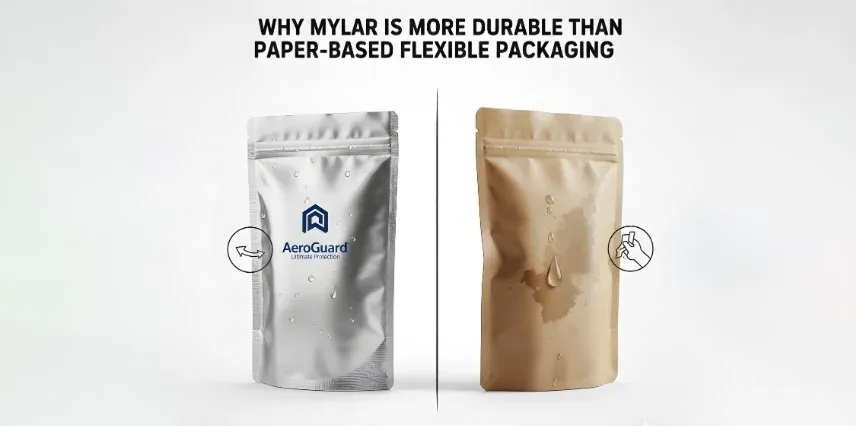
When it comes to product packaging, durability matters a lot. Especially when you have to store the products for longer periods, you should only opt for durable packaging. Paper-based packaging has gained popularity these days, but they often fall short in durability when compared to Mylar bags.
Understanding why Mylar bags are more durable than paper-based packaging is important for both consumers and business owners. It ensures your products remain safe, protected, and secure. This guide explains the differences in durability between paper packaging and Mylar bags.
What is Durability with Respect to Packaging
Durability is not limited to physical strength only. It is a measure of how well a box or pouch performs under real-world conditions.
The packaging is durable if it can:
- Resist puncture, tear, and physical damage
- Keep the ingredients intact under pressure
- Protect against moisture, light, and oxygen
- Withstand handling, shipment, and warehouse
- Preserve the product quality over longer periods
If it doesn’t meet this criterion, it is not durable packaging. Such materials can cause spoilage, degradation, and damage to the stored products.
Mylar vs Paper-Based Flexible Packaging
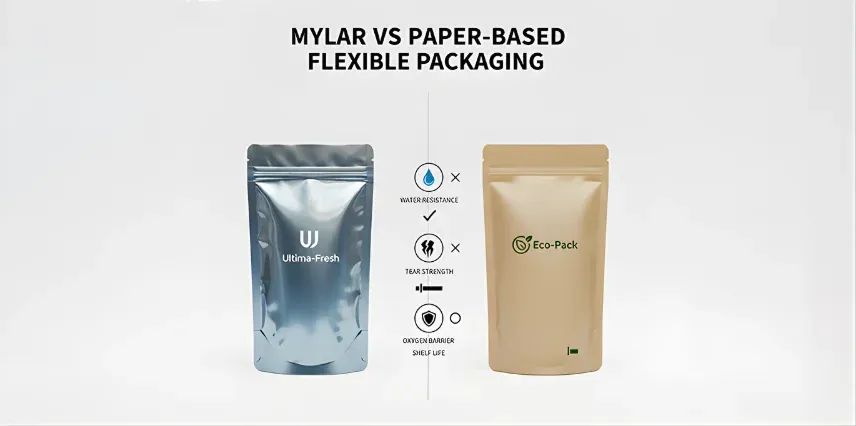
Mylar bags are more durable than traditional plastic bags, kraft paper bags, and even some glass jars. The reason is their unique structure, composition, and features.
Material Composition
This is the core reason Mylar bags outperform the paper-based packaging.
Mylar Structure
Mylar bags are composed of polyethylene terephthalate (PET), layered with aluminum or other coatings. This layered structure provides them with an extraordinary protective barrier. It can effectively block gases, sunlight, and humidity.
The key characteristics include:
- High tensile strength
- Smooth, sealed surface
- Strong puncture resistance
Paper-Based Flexible Packaging Structure
Paper-based flexible packaging is composed of plant fibers. It may include layers and coatings, but the core materials still remain the fibers.
The result is:
- Decreased strength when exposed to moisture
- Fibers weaken under pressure or friction
- Long-term durability is limited
This structural difference clearly implies that Mylar bags are more durable than paper-based flexible packaging.
Moisture and Humidity Resistance
Moisture is one of the biggest threats to packaging materials.
Mylar Performance
Mylar features an excellent barrier against moisture and humidity. Its non-porous structure blocks vapors and prevents them from getting in direct contact with the material inside. It helps maintain both the product quality and packaging integrity.
This makes Mylar suitable for:
- Storage in humid environments
- Storing moisture-sensitive products
- Long-term storage of food items
Paper-Based Packaging Performance
Paper-based packaging has a porous composition that absorbs moisture easily. Even coated layers lose their strength when they are exposed to a humid environment.
It leads to:
- Structural breakdown over time.
- Softening and warping of the box
- Reduced tear and puncture resistance
Puncture and Abrasion Resistance
Packaging materials are often subjected to stress and friction during handling or shipment.
Mylar Resistance
Mylar is significantly tougher yet smooth packaging material. It can:
- Provide resistance to tears and punctures
- Maintain shape even under high pressure
- Handle stress and friction very well
Paper-Based Flexible Packaging Resistance
Paper packaging has a brittle structure that ruptures easily when subjected to concentrated pressure.
It is:
- Prone to damage when folded.
- Vulnerable to punctures from sharp edges.
- Prone to abrasive damage and structural disorder.
For products that need a secuere transport and repeated handling, Mylar bags are a good choice.
Shelf Life
Mylar bags provide a much longer shelf-life, up to 25 to 30 years. This is because they block light, moisture, and gases. As a result, there are reduced chances for external interference and spoilage.
On the other hand, paper-based packaging can’t resist these environmental factors effectively. A slight exposure to negative factors and the process toward deterioration or damage starts immediately.
That’s why Mylar bags are the top pick when storage is required for longer periods.
Resistance to Oils, Fats, and Contaminants
Many products contain and release fats or oils. The response of the packaging materials to this fat content affects durability.
Mylar provides an inert shield against fats and oils, which means there are very rare chances that they can damage the pouch. On the other hand, paper-based flexible packaging is porous and can absorb fats and oils unless enriched with multiple coatings.
This difference makes Mylar more durable and a premium choice for storing food, supplements, and items that are sensitive to contamination.
When Paper-Based Flexible Packaging is Suitable
Although not as durable as Mylar bags, paper-based flexible packaging also has multiple benefits.
Here are the scenarios where it finds its application.
- Products are lightweight and non-sensitive
- Storage duration is short e.g household items
- Environmental aesthetics are prioritized
- Moisture and contamination risks are low
Using paper packaging in these situations can better meet the consumer’s practicality and aesthetic goals.
Conclusion
Durability is a very important factor in packaging performance. It varies greatly with the material, structure, composition, and additional features. When comparing Mylar to paper-based flexible packaging, Mylar consistently offers superior strength, barrier protection, and long-term reliability.
While it is not durable like Mylar, paper-based packaging also has multiple benefits. Especially, it is useful for aesthetics and short-term storage where the risks of moisture or contamination are low. Depending on your needs and preferences, you can choose between these two widely used solutions.
Whether you are looking for high-quality Mylar bags or standard paper-based flexible packaging, The Box Lane has you covered. Explore our popular options on the website or contact us for a custom quote.
FAQs
Why does paper packaging fail more frequently in high-humidity warehouses?
It is because paper is hygroscopic. It absorbs moisture, which breaks down cellulose fibers and weakens seal integrity. As a result, packaging fails in a short time.
Can paper-based flexible packaging meet 2026 PFAS-free regulations?
Yes, it is possible. There are already many solutions in the industry available to replace traditional oil- and grease-resistant coatings. But doing so leads to brittle coatings that crack at the gussets many times.
Does switching to paper affect my production line speed?
Yes, it can slow down the production line speed. It is because paper is an insulator and needs a long dwell time for heat sealing, as compared to Mylar bags that offer instant sealing options.
Is Mylar more puncture-resistant than reinforced kraft paper?
Yes, mylar bags are more puncture-resistant than kraft paper. It is also verified by ASTM D1709 testing. The biaxial orientation of Mylar bags allows them to be stretched, while paper lacks elasticity and results in tearing when a sharp edge is in contact.
Will Mylar bags protect against lipid wicking better than paper?
Yes, this is one of the excellent features of the Mylar bags. Mylar is resistant to fats, keeping the packaging dry and clean. On the other hand, paper boxes can absorb fat, causing rancidity and grease spots on the exterior.